Ripening Nutrition
This post is part of the full Ripening Room rollout — Crespo Organic’s dedicated education hub for understanding mango ripeness, from the science of how mangoes ripen to practical tools for shopping and eating them well. If you missed the details, catch up here. The complete Ripening Room launches on the Crespo Organic site just ahead of Summer Mango Mania, including a top-secret new ripening tool for mango shoppers.
For today, we continue with the science, Ripening Nutrition!
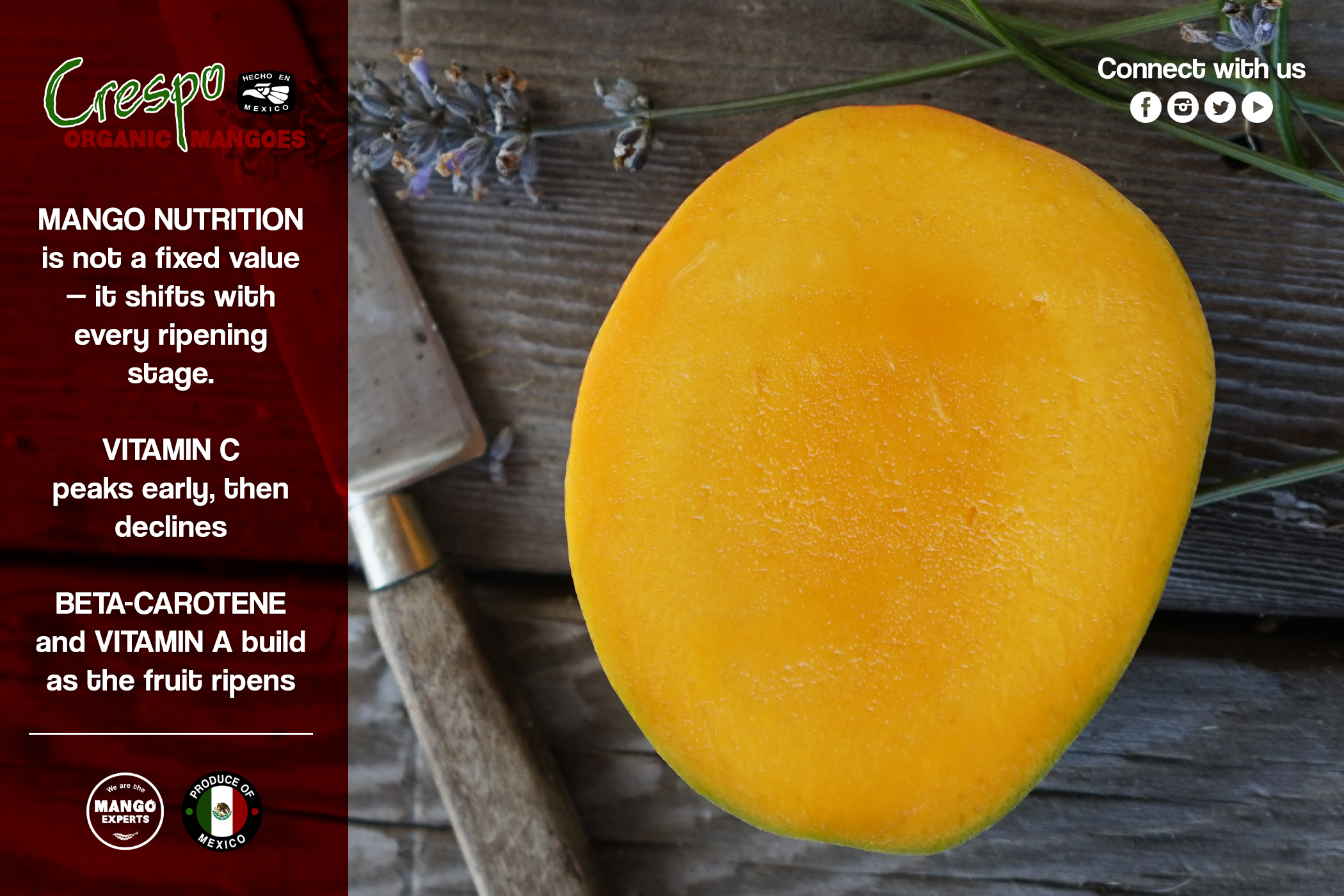
The nutritional content of a mango is not a fixed value. It shifts — sometimes dramatically — as the fruit moves through its ripening stages or gets abused (including in the hot water bath). Vitamin C peaks early and then decline with ripening. Beta-carotene and vitamin A build as the fruit ripens. Polyphenols surge through mid-ripening then taper. Fiber doesn’t disappear but changes its function entirely.
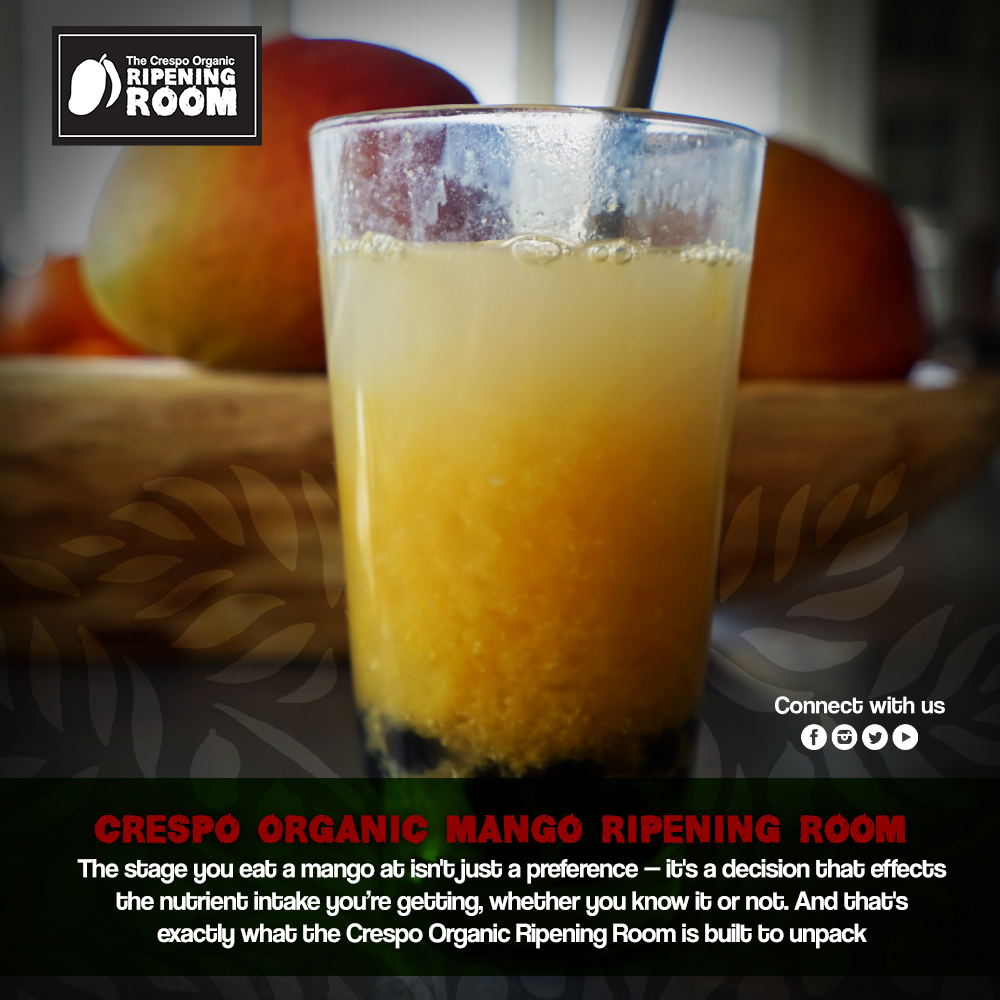
The stage of ripeness a mango is eaten in isn’t just a preference — it’s a decision that effects the nutrient intake. This is exactly what Crespo’s The Ripening Room aims to teach mango lovers with our Ripeness Nutrition.
When mango lovers understand the nutritional details behind each variety and ripeness stage, their relationship with the fruit changes entirely. Our consumer education work has shown this consistently — informed shoppers make better decisions right at the display, and that’s better for everyone in the mango business. The industry push for perfectly ripe mangoes at retail ignores two realities: nature cannot be controlled that precisely, and not every shopper wants a mango ready to eat today, especially if they are eating for nutritional specifics. The Crespo Organic Kitchen/Under the Mango Tree, and the #MangoEd we churn out exists to change cookie cutter approaches to the fruit — in the case of Ripening Nutrition giving shoppers the nutritional knowledge to shop and eat mangoes on their own terms.
What a firm, green mango delivers nutritionally is not what a soft, fragrant one delivers — even if it’s the same fruit, just days apart. And that’s before factoring in variety — a ripe Ataulfo and a ripe Kent are not nutritionally identical. Carotenoid profiles differ by varietal. Sugar composition differs. Polyphenol concentration differs. The mango is not a monolith, and treating it like one flattens a story that is actually rich with nutritional detail. All stages are worth eating — each with its own nutritional profile and culinary potential.
All varieties are worth understanding — and Variety Nutrition, coming in an upcoming post as part of the full Ripening Room campaign, will dig into exactly that. For now, the focus is Ripeness Nutrition: each stage is doing something different for the body, and that difference is one of the most compelling — and underreported — aspects of the mango in my opinion and I think it’s also what makes cooking across ripeness stages so valuable — the nutritional and culinary variance is built right in. Nature seems to be intentional that way.
Vitamin C — higher when green, declines as it ripens
Unripe mango has significantly higher vitamin C (ascorbic acid) concentration. As ripening progresses, vitamin C levels decline — naturally ripened mango drops vitamin C by about half when fully ripe. Still meaningful, but the green and semi-ripe stages (check out the stages of ripeness) are the peak vitamin C window. Keitt is notable here specifically — its slower ripening profile means it holds vitamin C longer than faster-ripening varieties, making it an outlier worth calling out and thus notable for its citrus forward flavor.
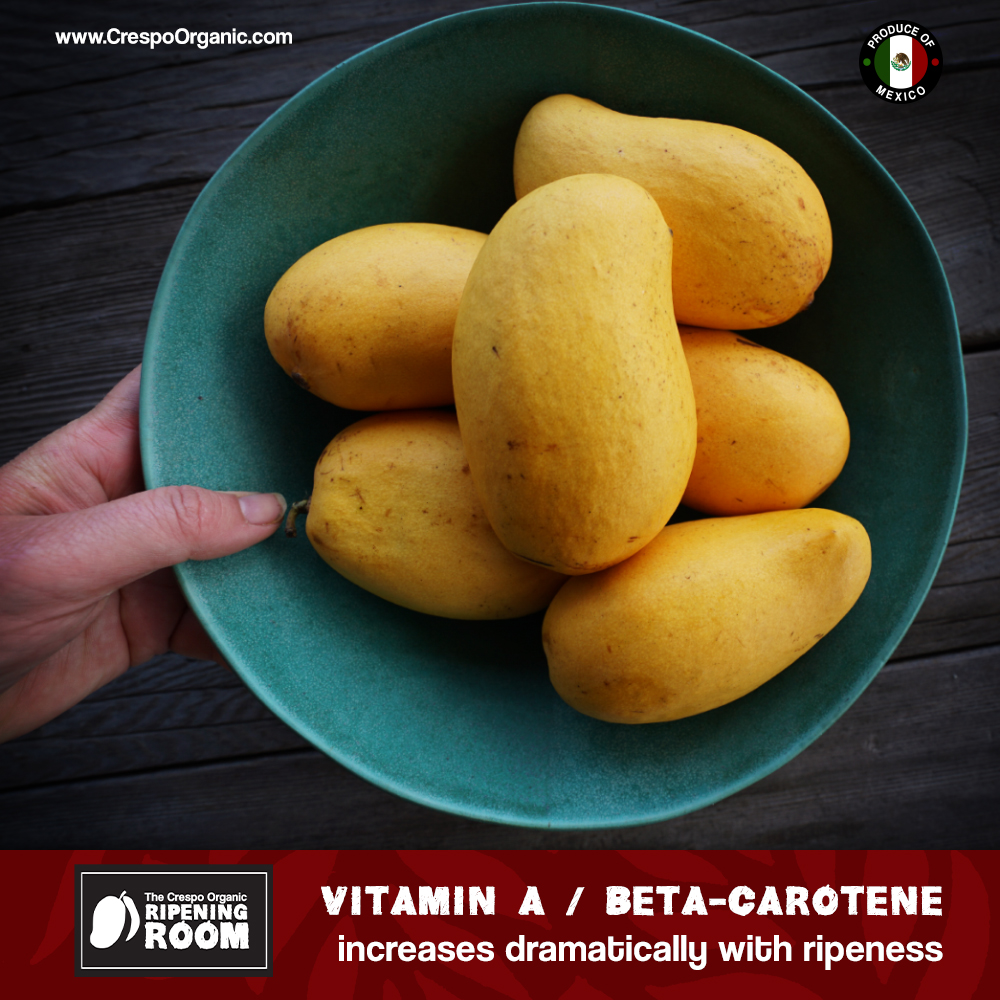
Vitamin A / Beta-Carotene — increases dramatically with ripeness
This is the big trade. Beta-carotene — the precursor to vitamin A — increases dramatically during ripening, going from a minor player when green to constituting 60% of all carotenoids in a fully ripe mango. Total carotenoid content in the peel increases approximately fivefold as the fruit ripens. The color change in the flesh — green to deep golden orange — is not just visual. It’s a direct indicator of beta-carotene concentration.
Varietal differences matter here too. Yellow-fleshed varieties like Ataulfo, Nam Doc Mai, and Mallika have a higher carotenoid ceiling than varieties like Tommy Atkins and Keitt, which retain more green in the flesh even at peak ripeness. Kent sits strong in the middle with deep golden flesh at full ripeness. The fivefold increase applies across varieties, but a ripe Ataulfo is delivering meaningfully more vitamin A potential than a ripe Tommy Atkins. The deeper the flesh color, the higher the vitamin A potential.
Potassium and Vitamin K — higher when green
Both are more concentrated in the unripe stage and decline slightly as sugars dilute the overall mineral concentration during ripening. The decline is not dramatic — a ripe mango is still a meaningful source of both — but green and semi-ripe mango delivers a more concentrated hit. Varietally, smaller-fruited varieties like Ataulfo, Nam Doc Mai, and Mallika tend to have higher nutrient density overall due to their lower water content and more concentrated flesh, which means their potassium and vitamin K values hold up better across ripeness stages than larger, higher-water varieties like Keitt or Tommy Atkins. If you’re eating mango for mineral content specifically, smaller varieties at the semi-ripe stage are your best case.
Omega-3 and Omega-6 Fatty Acids — increase with ripening
Lipid composition actually increases during ripening, particularly the beneficial fatty acids — and this is one of the most underreported aspects of mango nutrition in consumer education. The seed kernel is where mango fat content is most concentrated and has been studied extensively for its stearic and oleic acid profile, but the flesh itself does develop increased lipid content as ripening progresses. Varietally, higher-flesh-density varieties like Ataulfo, Nam Doc Mai and Mallika — with their thicker, creamier, lower-fiber flesh — show this more prominently than high-water, fibrous varieties like Tommy Atkins or Keitt. The creamy, almost buttery texture of a fully ripe Ataulfo is not accidental — it’s partly a reflection of that increased lipid development. This is worth pointing out specifically because it reframes the ripe mango as a source of beneficial fats, not just sugar, which runs counter to how most people think about fruit nutrition.
Polyphenols and Antioxidants — complex and stage-dependent
Total polyphenol content rises through mid-ripening then begins to decline in the fully ripe stage, which makes the semi-ripe stage arguably the most nutritionally complete eating window — peak polyphenol concentration alongside developing sugars, with fiber still predominantly insoluble. Mangiferin, the unique mango polyphenol with significant anti-inflammatory research behind it, is present across all stages but most concentrated in the peel — which most people discard without a second thought.
Varietally, Indian-lineage mangoes like Mallika show significantly higher mangiferin concentration than commercial export varieties. Ataulfo, despite its modest size, is also a strong polyphenol performer. Kent and Keitt run lower by comparison. The peel of any variety contains multiples of the concentration found in the flesh — meaning the most antioxidant-rich part of the mango is almost universally thrown away in Western eating culture. In South and Southeast Asian culinary traditions, the peel is eaten or used, and the nutrition science backs that habit entirely. I am actively developing peel recipes so stay tuned!
Fiber — shifts form, not volume
Total fiber doesn’t change dramatically but its structure does. Green mango fiber is predominantly insoluble, which supports digestion and gut motility — the kind of fiber that keeps things moving. As the mango ripens and pectin breaks down, more of that fiber becomes soluble, which feeds gut microbiome, slows sugar absorption, and supports cholesterol management. Different stages, genuinely different functional benefits.
Varietally, fiber content and texture vary enough to matter. Ataulfo and Mallika are notably low in fiber strands — their flesh is smooth and fibreless, which is part of their appeal, but it also means their total fiber contribution is lower than more fibrous varieties. Tommy Atkins and Kent have more pronounced fiber structure, particularly around the seed, which means they deliver more total fiber per serving. Keitt sits in the middle — moderately fibrous with a cleaner flesh than Tommy Atkins. For someone eating mango specifically with gut health in mind, a semi-ripe Tommy Atkins is going to outperform a ripe Ataulfo on fiber delivery, even though the Ataulfo wins on almost every other nutritional metric at peak ripeness.
Folate — higher when green, declines with ripeness
Mango is a meaningful source of folate and it’s one of the most overlooked nutrients in the fruit’s profile. Green and semi-ripe mango has higher folate concentration — folate is essential for cellular repair, DNA synthesis, and is particularly significant in the context of pregnancy nutrition. As ripening progresses, folate declines alongside other water-soluble nutrients. Varietally, smaller-fruited, denser varieties like Ataulfo and Mallika tend to have higher folate concentration than larger, higher-water varieties — another reason the small varieties punch above their weight nutritionally.
Copper and Trace Minerals — more concentrated when green
Mango contains copper and other trace minerals including zinc and magnesium, all more concentrated in the unripe stage as sugars dilute overall mineral density during ripening. Copper in particular supports iron absorption and connective tissue health — a functional benefit that rarely makes it into consumer mango education. As with potassium and vitamin K, the mineral story of mango favors the green and semi-ripe stages, and denser-fleshed varieties deliver more concentrated mineral content than high-water varieties like Keitt and Tommy Atkins.
Enzymatic Activity — peaks at full ripeness
This one connects directly back to the ripening science. The amylase enzymes that break down starch inside the mango during ripening are also active digestive enzymes when you eat the fruit — meaning a ripe mango is actually helping you digest the carbohydrates you’re consuming. Additional proteolytic enzymes present in ripe mango support protein digestion as well. This is almost never discussed in consumer mango education and it reframes the ripe mango not just as a sugar delivery vehicle but as a digestive aid. The more fully ripe the fruit, the higher the enzymatic activity.
Glycemic Impact — significantly lower when green and semi-ripe
This may be the most practically important entry in this entire section for a wide audience. Green and semi-ripe mango has a significantly lower glycemic impact than fully ripe due to higher resistant starch content and predominantly insoluble fiber, both of which slow sugar absorption and blunt the blood sugar response. As the mango ripens and starch converts to sugar, the glycemic load increases. A fully ripe mango is still a whole fruit with fiber, enzymes, and micronutrients moderating its impact — it is not candy — but the green and semi-ripe stages are genuinely appropriate for people managing blood sugar who have been told to avoid mango entirely. That’s a powerful and underserved message, and it ties the ripeness framework directly into a health conversation that reaches far beyond the typical mango consumer. Varietally, Ataulfo and Mallika — with their higher sugar ceilings at peak ripeness — have a higher glycemic load when fully ripe than lower-Brix varieties like Keitt, which is worth noting for anyone eating with blood sugar specifically in mind.
Every stage has a nutritional argument. Green and semi-ripe deliver vitamin C, folate, potassium, vitamin K, polyphenols, trace minerals, insoluble fiber, and a lower glycemic impact. Ripe delivers vitamin A, beta-carotene, omega fatty acids, soluble fiber, antioxidant carotenoids, and active digestive enzymes. No stage is wrong, and no stage is nutritionally empty. That’s a powerful counter-narrative to the idea that a mango has to be fully ripe to be worth eating — and it ties directly into Under The Mango Tree/ Crespo’s 4-stage ripeness framework. Eat it firm, eat it yielding, eat it soft — just eat it with intention.
Stay tuned for my Mango Recipes for Optimized Nutrition, of which I will show you how to maximize nutrition based on ripeness!